Nexcore builds custom business systems and the operating systems that run them, through one verified factory loop.

The software factory

We build the operating systems that run your business.

Custom platforms — quoting, dispatch, invoicing, field ops, command centers — each ready for the brain add-on, built from your context, your rules, your flows, your memory, your permissions. You own the code.

Why we're different

Everyone says "AI & automation consulting". We'll show you the factory instead.

Most custom software is built once, by hand, and every project starts from zero. We built a factory: a standardised build loop with the same documentation, the same verification gate, and the same shape of output every time. That's why the second system costs less than the first — and why you can read exactly what was built.

One repeatable loop

Spec → audit → build → browser-verify → document → ship. Every slice, every project, no exceptions. The loop does not get shortened because a date moved.

Verified, not "should work"

Every slice is driven in a real browser before it counts as done — including the failure branches, not just the happy path. "It compiles" is not evidence.

You own everything

Your code, your GitHub, your database, your hosting. No lock-in, no per-seat licence on your own operations. Fire us tomorrow and the system keeps running.

You watch it happen

Your own portal from day one — see where your build is in real time, request changes, follow billing, and get training built for your team, not a generic manual. What owning one is like →

How it works

Your operation, rebuilt as one system.

What arrives is the mess; what leaves is one platform you own. The six steps in the middle are the whole method — boring on purpose, verified in a real browser before anything counts as done.

What we build

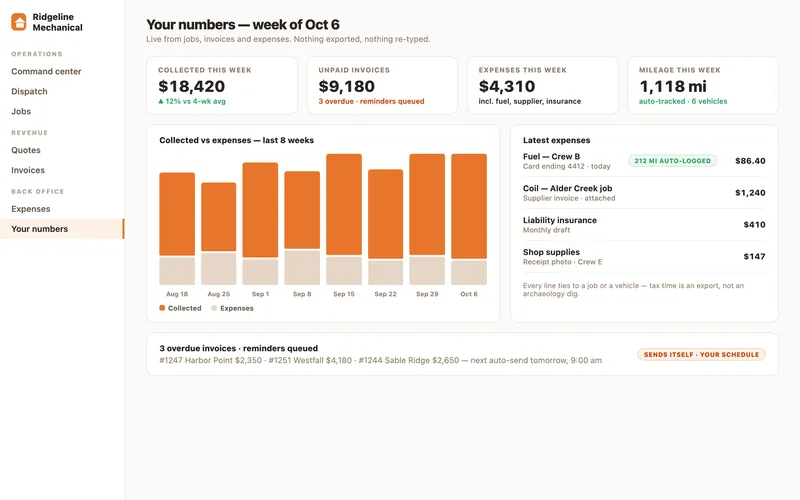
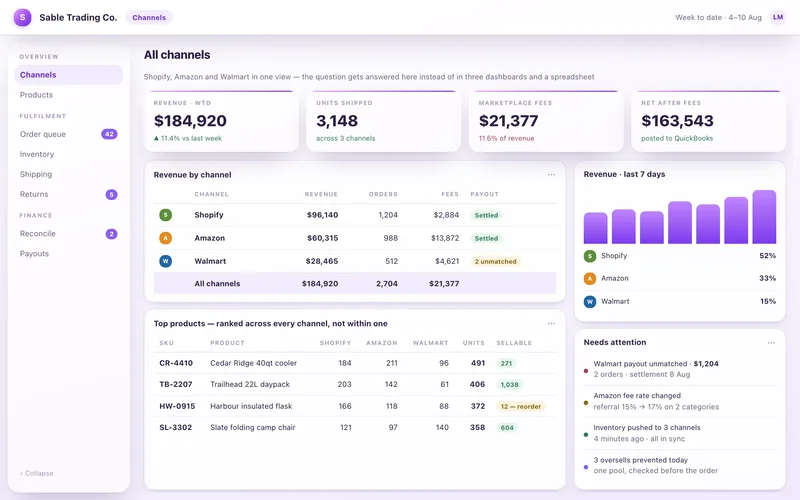
Screens from systems that run real operations

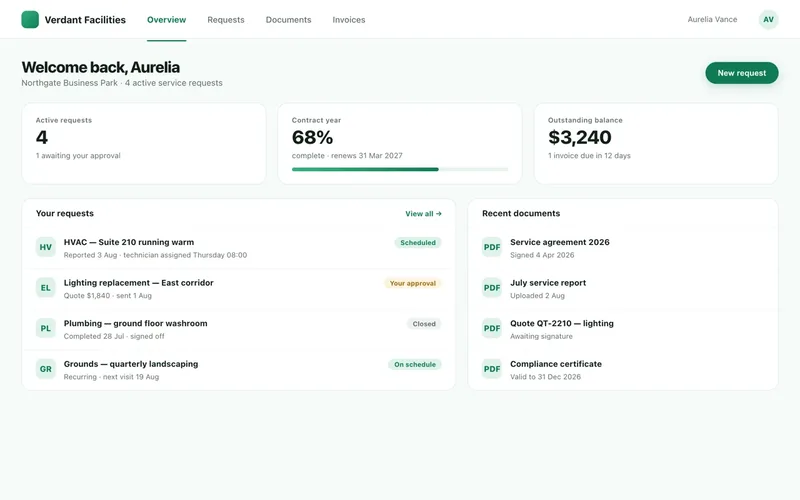
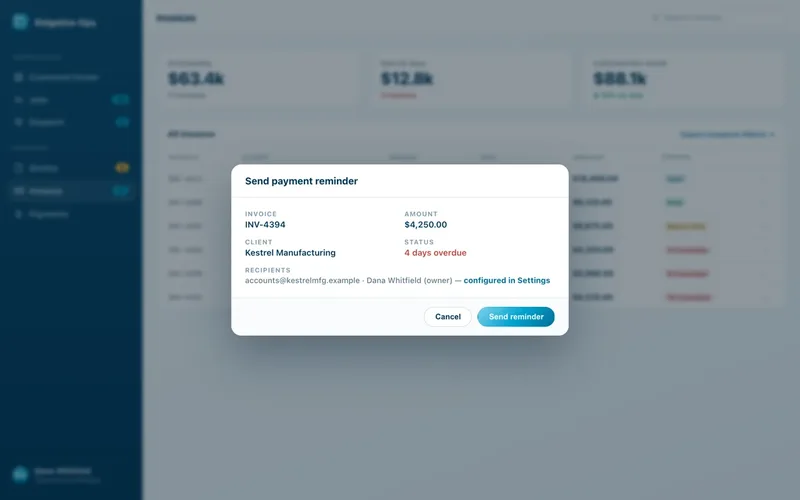
Purpose-built demos rather than client screenshots — our clients haven't given permission to be named, so the companies, people and figures in them are invented. The capabilities are not.

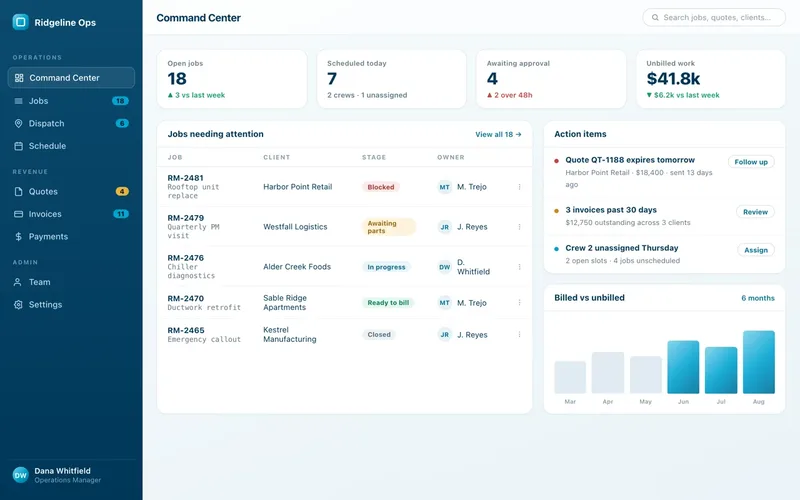
A command-center dashboard showing open jobs, work scheduled today, approvals awaiting action and unbilled revenue, alongside a jobs table and prioritised action items.
Command center. Quote → dispatch → job → invoice in one platform, surfacing what needs attention before anyone goes looking for it.
A dark operations-intelligence dashboard with throughput, cycle time, exception and margin tiles, a live process graph highlighting a bottleneck, and a feed of live exceptions.
Operations intelligence. A live process graph showing where work is actually piling up, with exceptions raised the moment a threshold is crossed.
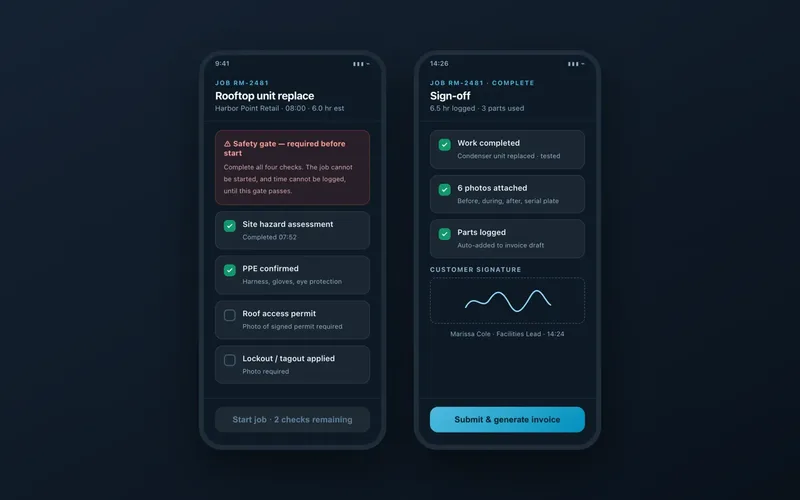
Two phone screens from a field technician app: a safety gate blocking job start until four checks pass, and the sign-off screen with photos, parts logged and a customer signature.
Field app with hard safety gates. A job cannot start until every check passes — and the blocked state is built and verified as carefully as the happy path.
A construction schedule in Gantt view showing a slipped framing inspection, six downstream tasks moved automatically, and panels summarising cascade impact and trades to re-notify.
Cascading schedule. One slipped inspection moves every downstream task, updates the handover date and flags exactly which trades need re-notifying.

Proof

Systems running real businesses today

Every number here comes from a build record. Where we don't have a figure we can point at a source for, we don't publish one — which is why you won't find an ROI percentage or a cost-saving claim anywhere on this site.

683/683

Every test passing

on a live field-service platform, in production

611

Tests on a second build

a construction scheduling system

873+

Engineering hours logged

read from build records — not typed into this page · as of 27 Aug 2026

Tell us what's slow.

A short call, no pitch. We'll tell you on that call if we're not the right fit, rather than three weeks into a proposal.